Dante
Garetto
← All projects

Cargility Customer Discovery

My Role
UX Researcher (course project)
Location
Ann Arbor, MI
Tools
  • FigJam
  • Zoom
  • Canva
Timeline
January – April 2026
Tags
  • UX Research
  • Inclusive & Accessible Design
  • Stakeholder & Client Management
  • Healthcare & Accessibility
  • Research Study

What

Learn how people with balance and stability challenges, and the caregivers who help them, get in and out of cars, and what would make them trust a product built for it — for a startup that had nothing to show us yet.

Context

Cargility, a Michigan startup, was building a product to help people with balance and stability challenges get in and out of vehicles, and could not yet show it to anyone. In SI 311, our team of five UX researchers ran 30 semi-structured interviews of about 20 minutes each, over Zoom and in person, with two groups: people who struggle with vehicle entry and exit themselves, and the family members and professionals who help them. Participants came through a screener with written inclusion and exclusion criteria. Questions asked about behavior rather than opinion, and branched on whether someone had used a solution, looked without buying, or never looked. We pulled out every quote by participant, coded each group's quotes into themes, built two personas and two journey maps from them, and presented our recommendations to Cargility.
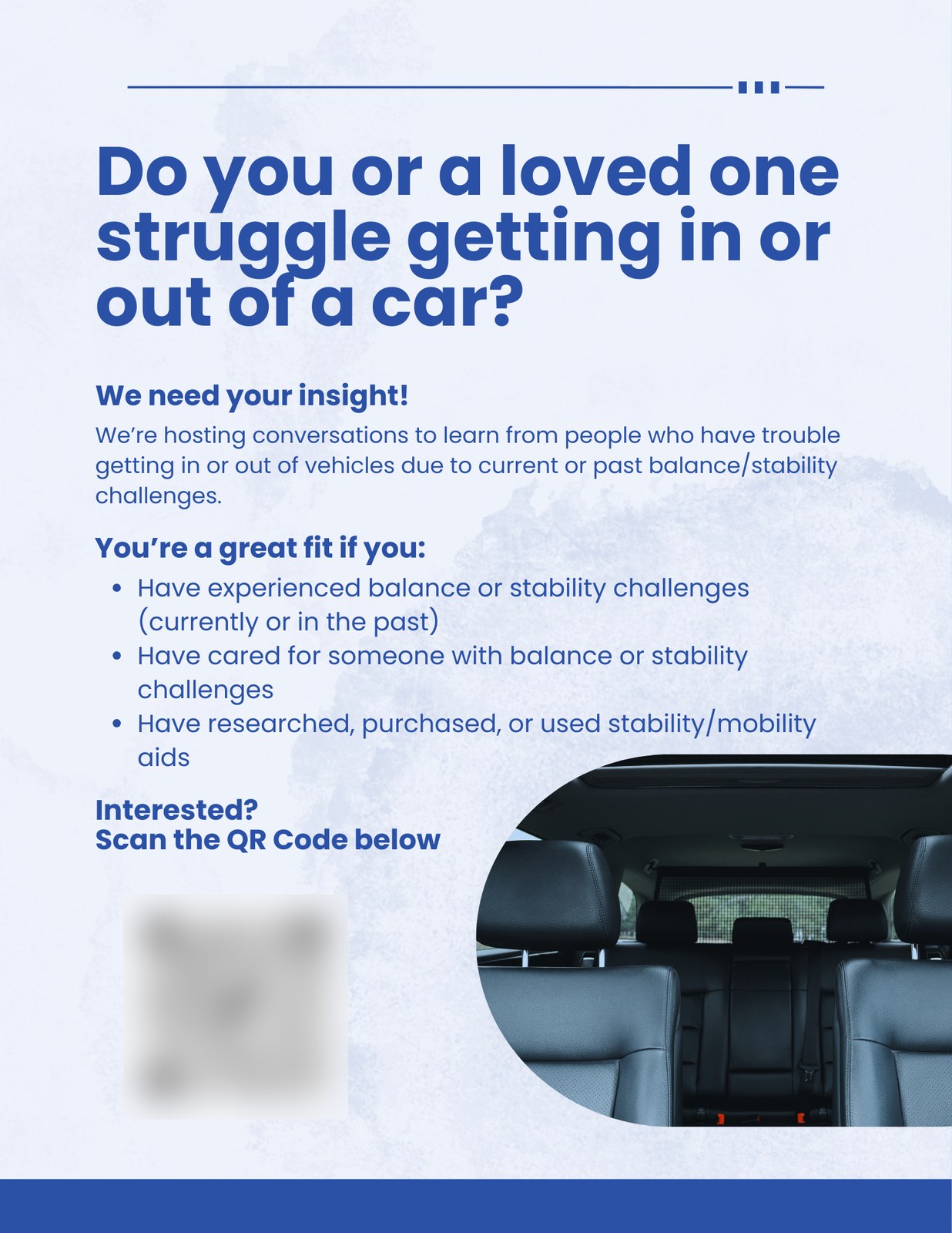
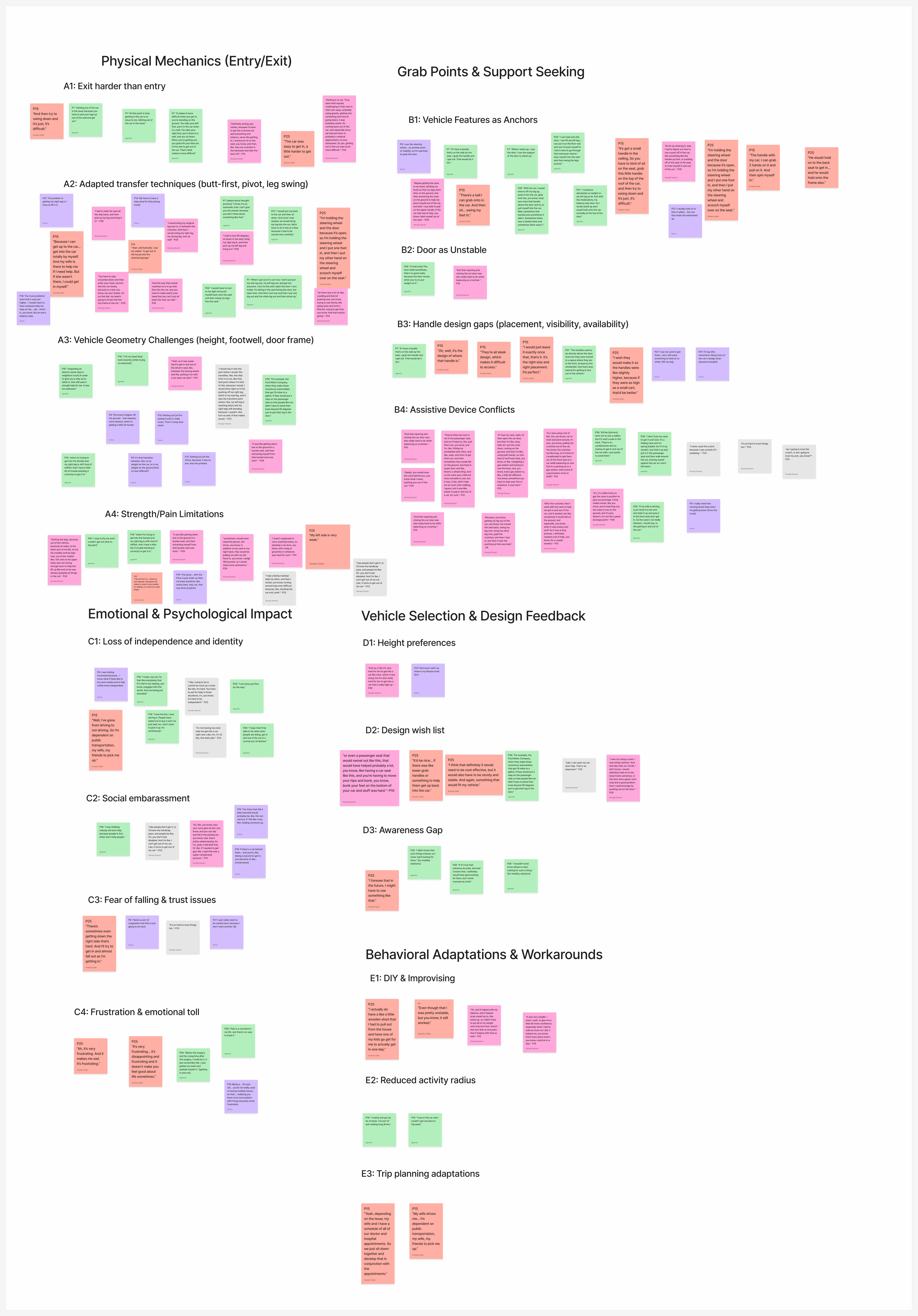
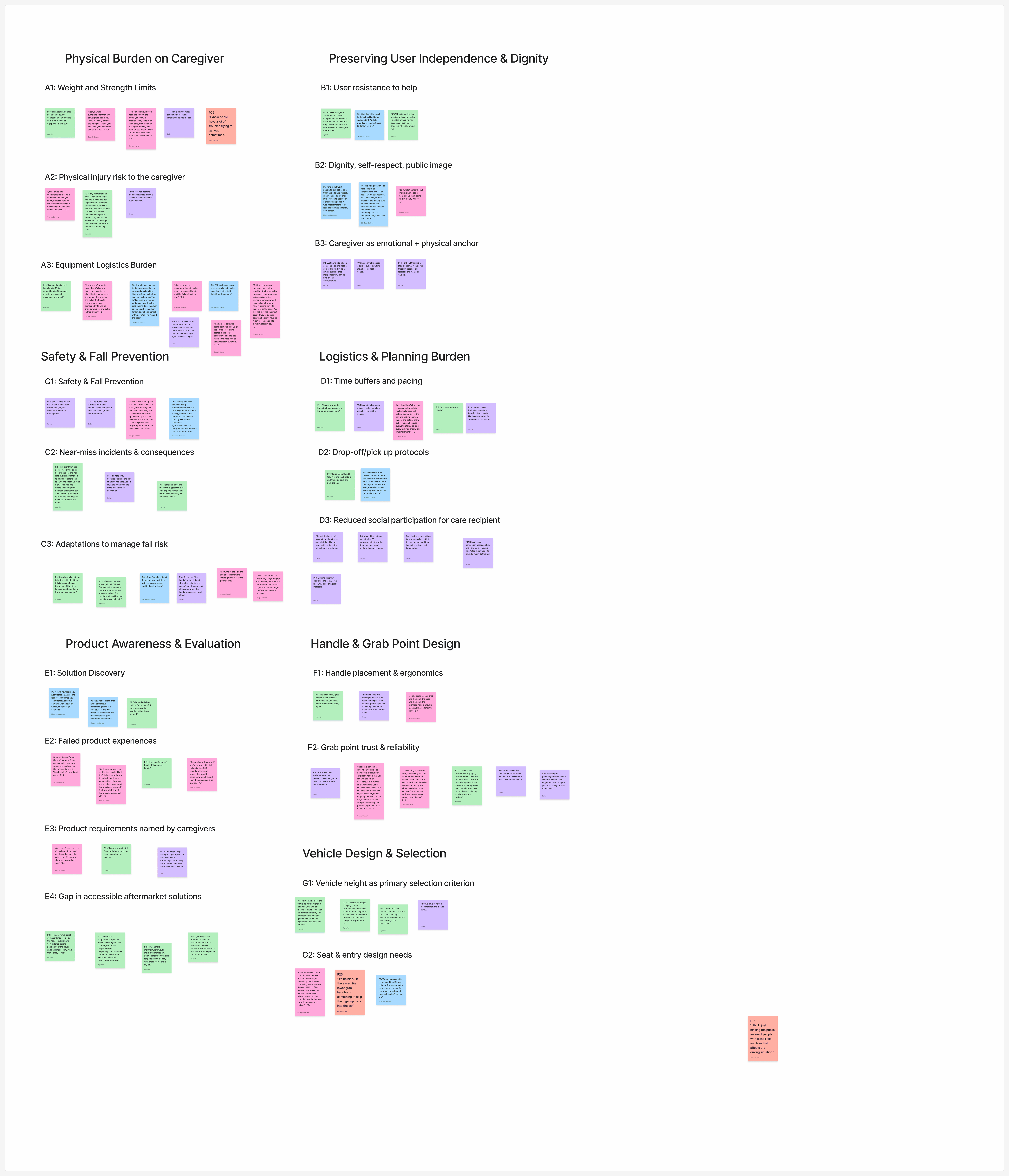
The recruitment flyer, then every quote coded by theme: people with stability challenges, and caregivers

Getting out of the car is the issue because you have to pull your legs up out of the well and get out.

I’m relying a lot on my own strength. I realized that when the car is higher up, I have to use my arm strength to pull my body up.

It’s very frustrating… it’s disappointing and frustrating and it doesn’t make you feel good about life sometimes.

Participants P7, P12 and P25, anonymized

Constraints

  1. No product to test. Cargility had nothing it could show us, so we studied the problem — the transfer itself, and how people find and choose aids — rather than a design.
  2. Participants who are hard to reach. Our first round was all caregivers, PT clinics and senior centers rarely replied, and our own networks skewed young. NextDoor posts reached older adults across Ann Arbor, and we tightened the screener after one participant’s difficulty turned out to be cognitive rather than physical.
  3. Twenty minutes a conversation. Every question had to earn its place, so the guide changed between rounds: we added walk-throughs of what people actually hold onto, and cut questions that proved redundant or did not sound conversational.
  4. Second-hand accounts. Some caregivers described what they assumed the person felt rather than what they had seen, so we weighed stated needs against described behavior before calling anything a finding.

Key Findings

  1. Getting out is the hard part

    Exit was harder than entry: lifting each leg out of a deep footwell, then standing with nothing solid to push against — worse in a garage, where the door cannot open fully.

  2. The car is the handrail, and a poor one

    People brace on the door, the frame, the seat back or a headrest. The door swings, and assist handles have moved forward, away from where a hand reaches when getting in.

  3. No two cars agree

    Seat height, footwell depth and handle placement change from car to car, so caregivers choose vehicles by height, and a tool that fits one car fails in the next.

  4. Aids lose to seconds and pounds

    A walker too clumsy to load stays home; a caregiver who can lift 15 pounds cannot lift 60. If a tool takes longer to set up than the transfer it saves, it is abandoned.

  5. Nobody knows the products exist

    Many had never searched for a solution. Those who had found generic “as seen on TV” gadgets they could not test before buying, and some broke in use.

  6. Dignity decides adoption

    Nearly every interview surfaced resistance to looking frail or disabled in public. A device that reads as medical goes unused, however well it works.

Final Deliverable

Persona

Margaret

Solo Senior, independence-oriented

Age
71
Occupation
Retired
Lives
Alone, near family
Mobility aid
Cane or walker
Vehicle
SUV
Tech comfort
Moderate

I hope that I’ll be able to do what other people are doing, get in and out of the car in a normal sort of fashion.

P26

Pain points

  • Never knew solutions existedI didn’t know that such things existed, so I never went looking for them. P26
  • Supports that move from car to carThe handles used to be directly above the door. And now they have moved to a space where they are in the front… And that’s less natural for getting in and out of the vehicle. P21
  • Fear of falling againI just really need to be careful here, because I don’t want another fall. P27
  • Being seen to struggleYou can slip and fall in the parking lot, you know. Like, that’s pretty embarrassing. P10

Persona

Diane

Part-time Caregiver, central pillar of support

Age
57
Occupation
Works part-time
Cares for
A family member
Role
Buys every aid
Vehicle
Sedan
Tech comfort
High

I mean, we’ve got all of these things for inside the house, but we have very little for getting people out of the house and back into society. And that’s crazy to me.

P21

Pain points

  • Her own body is the safety netI can handle 15, but I cannot handle 60 pounds of putting a piece of equipment in and out. P11
  • Products that broke her trustI tried all these different kinds of gadgets. Some were actually downright dangerous, and you just kind of toss them out. P24
  • A different problem in every carI think the hardest one would be if it’s a higher, a high rise SUV kind of car… it’s too high for her and she’s not very tall. P1
  • Dignity in publicIn public, it was important for her to look like she was a mobile, able person. P5

Cargility’s product, launched after the study (opens in a new tab) ↗

Reflection

We recommended that Cargility seek medical endorsement, lead with real users’ testimonials and tutorial videos, and frame the product around independence rather than disability. Cargility has since launched a portable, foldable vehicle handrail that fits most cars without modification, is rated to 300 pounds, is “validated by real users with balance challenges”, and is sold to keep people “moving on your terms.” We never saw the product and Cargility has not credited our research, but its claims answer, almost point for point, what our participants told us.

The interview guide is what I learned to design. The questions that worked did not ask how people felt about getting out of a car; they asked them to walk us through the last time, and what their hand was on. Behavior gave us findings a product could act on — the footwell, the swinging door — where opinion gave us adjectives.

What I would do differently is reach the people who struggle most from the first week. Our first round was all caregivers, and the older adults who most need this came late, through NextDoor. Setting up physical visits with senior centers and PT offices right from the start, rather than emailing them with general inquiries, would have put those voices at the center of the study early on instead of at the end.

← All projects

Cargility Customer Discovery

Cargility · UX Researcher (course project) · January – April 2026 · Ann Arbor, MI

Tools: FigJam, Zoom, Canva

  • UX Research
  • Inclusive & Accessible Design
  • Stakeholder & Client Management
  • Healthcare & Accessibility
  • Research Study
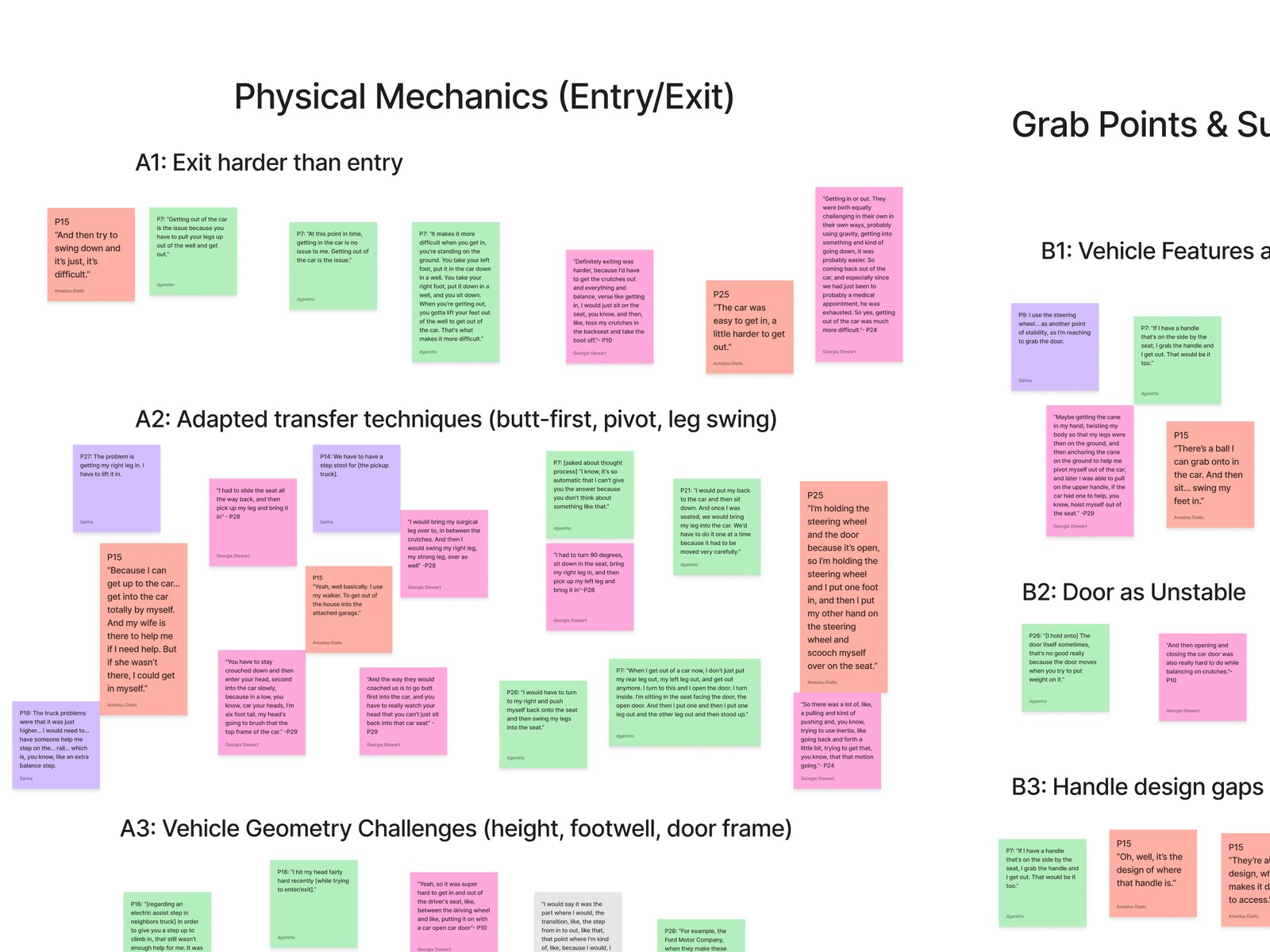
Coded interview quotes on a FigJam board under the heading “Physical Mechanics (Entry/Exit)”, starting with the code “A1: Exit harder than entry”.Full size (opens the file)

Learn how people with balance and stability challenges, and the caregivers who help them, get in and out of cars, and what would make them trust a product built for it — for a startup that had nothing to show us yet.

Context

Cargility was building a product for people with balance and stability challenges getting in and out of vehicles, and could not yet show it to anyone. Our team of five ran 30 interviews with those people, and with those who help them.

Read the full context

Cargility, a Michigan startup, was building a product to help people with balance and stability challenges get in and out of vehicles, and could not yet show it to anyone. In SI 311, our team of five UX researchers ran 30 semi-structured interviews of about 20 minutes each, over Zoom and in person, with two groups: people who struggle with vehicle entry and exit themselves, and the family members and professionals who help them. Participants came through a screener with written inclusion and exclusion criteria. Questions asked about behavior rather than opinion, and branched on whether someone had used a solution, looked without buying, or never looked. We pulled out every quote by participant, coded each group's quotes into themes, built two personas and two journey maps from them, and presented our recommendations to Cargility.
The recruitment flyer, with three ways to qualify.
A recruitment flyer headed “Do you or a loved one struggle getting in or out of a car?”, listing three ways to qualify — balance or stability challenges, caring for someone who has them, or having researched or used mobility aids — beside a photograph of a car interior. The QR code is blurred.Cropped · full image (opens the whole file)
Every quote coded by theme — starting with ‘A1: Exit harder than entry’.
The coded quotes from people with stability challenges: colored sticky notes, each a quote tagged with a participant number, under five themes — Physical Mechanics, Grab Points & Support Seeking, Emotional & Psychological Impact, Vehicle Selection & Design Feedback, and Behavioral Adaptations & Workarounds — each split into lettered codes such as “A1: Exit harder than entry” and “B2: Door as unstable”.Cropped · full image (opens the whole file)
Caregivers’ quotes, under seven themes of their own.
The coded quotes from caregivers, under seven themes — Physical Burden on Caregiver, Preserving User Independence & Dignity, Safety & Fall Prevention, Logistics & Planning Burden, Product Awareness & Evaluation, Handle & Grab Point Design, and Vehicle Design & Selection — each split into lettered codes.Cropped · full image (opens the whole file)

The recruitment flyer, then every quote coded by theme: people with stability challenges, and caregivers

Getting out of the car is the issue because you have to pull your legs up out of the well and get out.

I’m relying a lot on my own strength. I realized that when the car is higher up, I have to use my arm strength to pull my body up.

It’s very frustrating… it’s disappointing and frustrating and it doesn’t make you feel good about life sometimes.

Participants P7, P12 and P25, anonymized

Constraints

  1. No product to test

    Cargility had nothing it could show us, so we studied the problem — the transfer itself, and how people find and choose aids — rather than a design.

  2. Participants who are hard to reach

    Our first round was all caregivers, PT clinics and senior centers rarely replied, and our own networks skewed young. NextDoor posts reached older adults across Ann Arbor, and we tightened the screener after one participant’s difficulty turned out to be cognitive rather than physical.

  3. Twenty minutes a conversation

    Every question had to earn its place, so the guide changed between rounds: we added walk-throughs of what people actually hold onto, and cut questions that proved redundant or did not sound conversational.

  4. Second-hand accounts

    Some caregivers described what they assumed the person felt rather than what they had seen, so we weighed stated needs against described behavior before calling anything a finding.

Key Findings

  1. Getting out is the hard part

    Exit was harder than entry: lifting each leg out of a deep footwell, then standing with nothing solid to push against — worse in a garage, where the door cannot open fully.

  2. The car is the handrail, and a poor one

    People brace on the door, the frame, the seat back or a headrest. The door swings, and assist handles have moved forward, away from where a hand reaches when getting in.

  3. No two cars agree

    Seat height, footwell depth and handle placement change from car to car, so caregivers choose vehicles by height, and a tool that fits one car fails in the next.

  4. Aids lose to seconds and pounds

    A walker too clumsy to load stays home; a caregiver who can lift 15 pounds cannot lift 60. If a tool takes longer to set up than the transfer it saves, it is abandoned.

  5. Nobody knows the products exist

    Many had never searched for a solution. Those who had found generic “as seen on TV” gadgets they could not test before buying, and some broke in use.

  6. Dignity decides adoption

    Nearly every interview surfaced resistance to looking frail or disabled in public. A device that reads as medical goes unused, however well it works.

Final Deliverable

Persona

Margaret

Solo Senior, independence-oriented

I hope that I’ll be able to do what other people are doing, get in and out of the car in a normal sort of fashion.

P26
Facts and pain points
Age
71
Occupation
Retired
Lives
Alone, near family
Mobility aid
Cane or walker
Vehicle
SUV
Tech comfort
Moderate
  • Never knew solutions existedI didn’t know that such things existed, so I never went looking for them. P26
  • Supports that move from car to carThe handles used to be directly above the door. And now they have moved to a space where they are in the front… And that’s less natural for getting in and out of the vehicle. P21
  • Fear of falling againI just really need to be careful here, because I don’t want another fall. P27
  • Being seen to struggleYou can slip and fall in the parking lot, you know. Like, that’s pretty embarrassing. P10
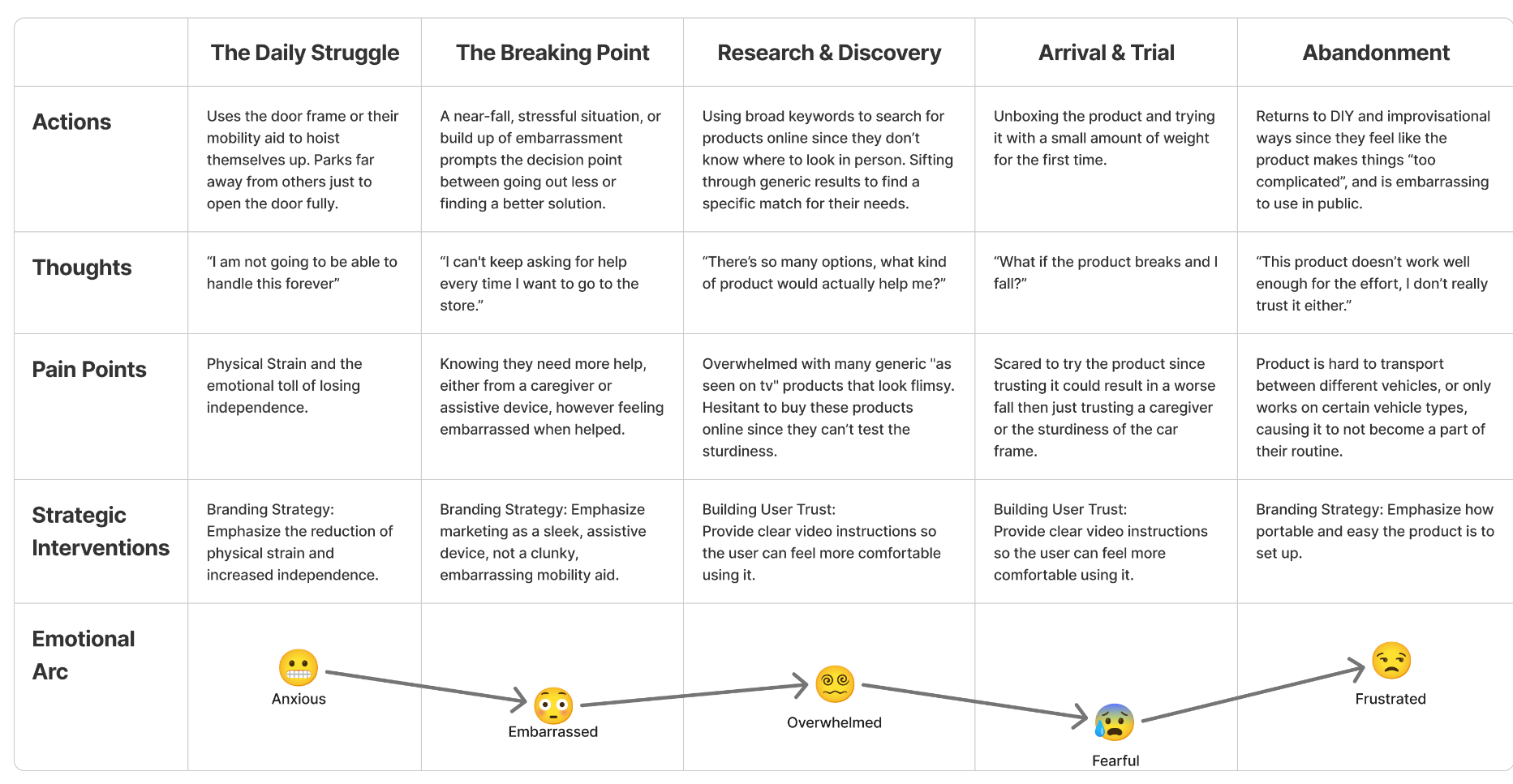
The Solo Senior’s journey, stage one: hoisting up on the door frame — Anxious.
Journey map for the Solo Senior, in five stages — The Daily Struggle, The Breaking Point, Research & Discovery, Arrival & Trial, Abandonment — with rows for actions, thoughts, pain points and strategic interventions, and an emotional arc running Anxious, Embarrassed, Overwhelmed, Fearful, Frustrated.Cropped · full image (opens the whole file)
…to Abandonment: back to DIY — Frustrated.
Journey map for the Solo Senior, in five stages — The Daily Struggle, The Breaking Point, Research & Discovery, Arrival & Trial, Abandonment — with rows for actions, thoughts, pain points and strategic interventions, and an emotional arc running Anxious, Embarrassed, Overwhelmed, Fearful, Frustrated.Cropped · full image (opens the whole file)

Persona

Diane

Part-time Caregiver, central pillar of support

I mean, we’ve got all of these things for inside the house, but we have very little for getting people out of the house and back into society. And that’s crazy to me.

P21
Facts and pain points
Age
57
Occupation
Works part-time
Cares for
A family member
Role
Buys every aid
Vehicle
Sedan
Tech comfort
High
  • Her own body is the safety netI can handle 15, but I cannot handle 60 pounds of putting a piece of equipment in and out. P11
  • Products that broke her trustI tried all these different kinds of gadgets. Some were actually downright dangerous, and you just kind of toss them out. P24
  • A different problem in every carI think the hardest one would be if it’s a higher, a high rise SUV kind of car… it’s too high for her and she’s not very tall. P1
  • Dignity in publicIn public, it was important for her to look like she was a mobile, able person. P5
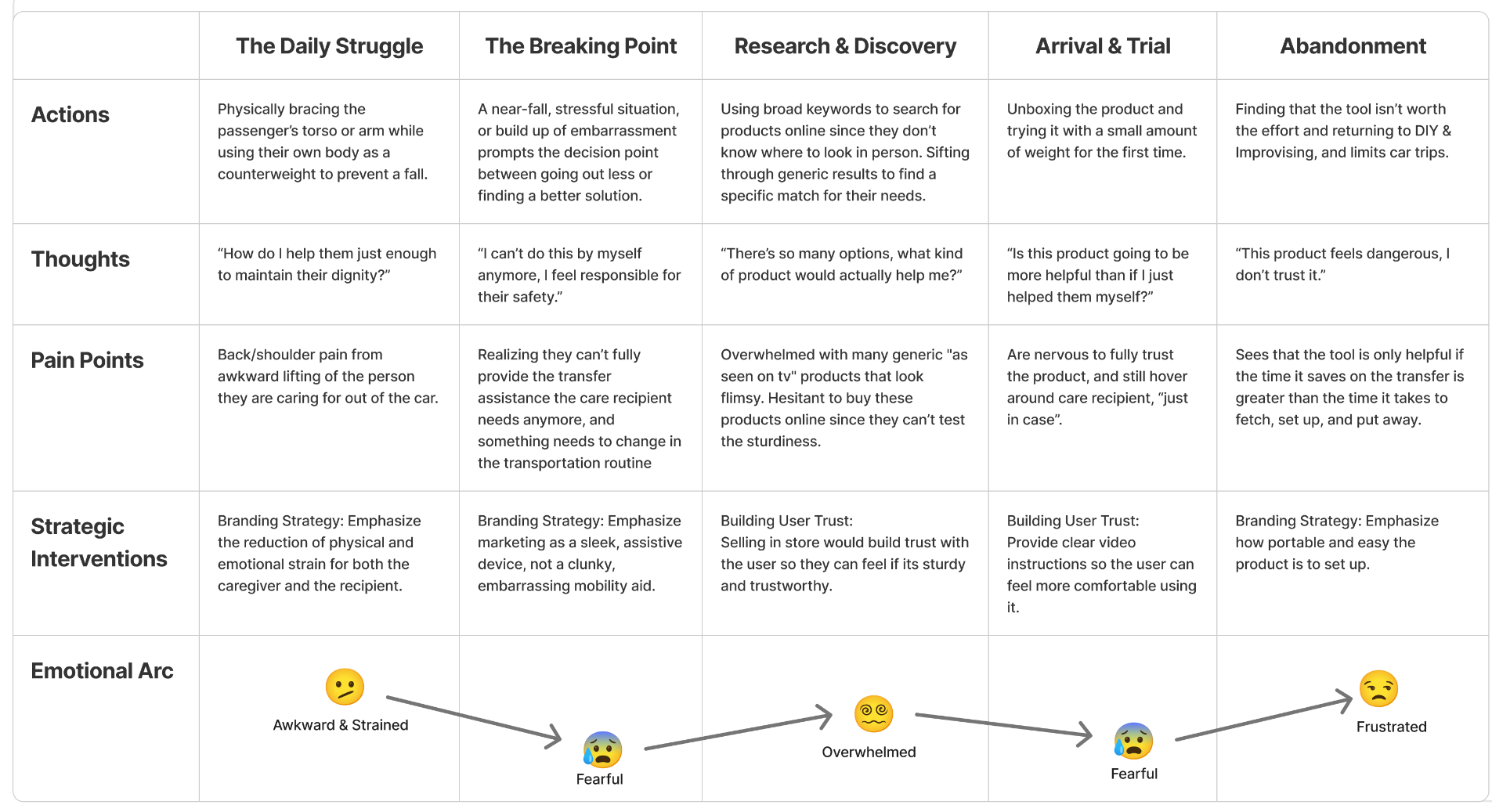
The Part-time Caregiver’s journey, stage one: bracing the passenger with their own body.
Journey map for the Part-time Caregiver across the same five stages, from physically bracing the passenger with their own body to abandoning a tool that takes longer to set up than it saves, with an emotional arc running Awkward & Strained, Fearful, Overwhelmed, Fearful, Frustrated.Cropped · full image (opens the whole file)

Reflection

Cargility has since launched a handrail whose claims answer, almost point for point, what our participants told us. What I learned to design was the interview guide.

Read the full reflection

We recommended that Cargility seek medical endorsement, lead with real users’ testimonials and tutorial videos, and frame the product around independence rather than disability. Cargility has since launched a portable, foldable vehicle handrail that fits most cars without modification, is rated to 300 pounds, is “validated by real users with balance challenges”, and is sold to keep people “moving on your terms.” We never saw the product and Cargility has not credited our research, but its claims answer, almost point for point, what our participants told us.

The interview guide is what I learned to design. The questions that worked did not ask how people felt about getting out of a car; they asked them to walk us through the last time, and what their hand was on. Behavior gave us findings a product could act on — the footwell, the swinging door — where opinion gave us adjectives.

What I would do differently is reach the people who struggle most from the first week. Our first round was all caregivers, and the older adults who most need this came late, through NextDoor. Setting up physical visits with senior centers and PT offices right from the start, rather than emailing them with general inquiries, would have put those voices at the center of the study early on instead of at the end.
  • UX Research
  • Inclusive & Accessible Design
  • Stakeholder & Client Management
  • Healthcare & Accessibility
  • Research Study
← All projects